Table of Contents
- Introduction
- Quick facts
- What is TEVTA
- TEVTA by province
- TEVTA programs and top trades
- Diplomas and long courses
- Short courses and certificates
- TEVTA courses after matric (who can join)
- Fee ranges and cost table
- Course duration and timeline table
- Admission process step by step
- Eligibility rules and documents required
- Job outcomes and expected salaries
- Best TEVTA courses for girls
- Internships, apprenticeships and on the job training
- Accreditation, certificate value and recognition
- Tips to choose the right TEVTA course
- FAQ (short answers)
- Conclusion
- About DailyPostJob.com
Introduction
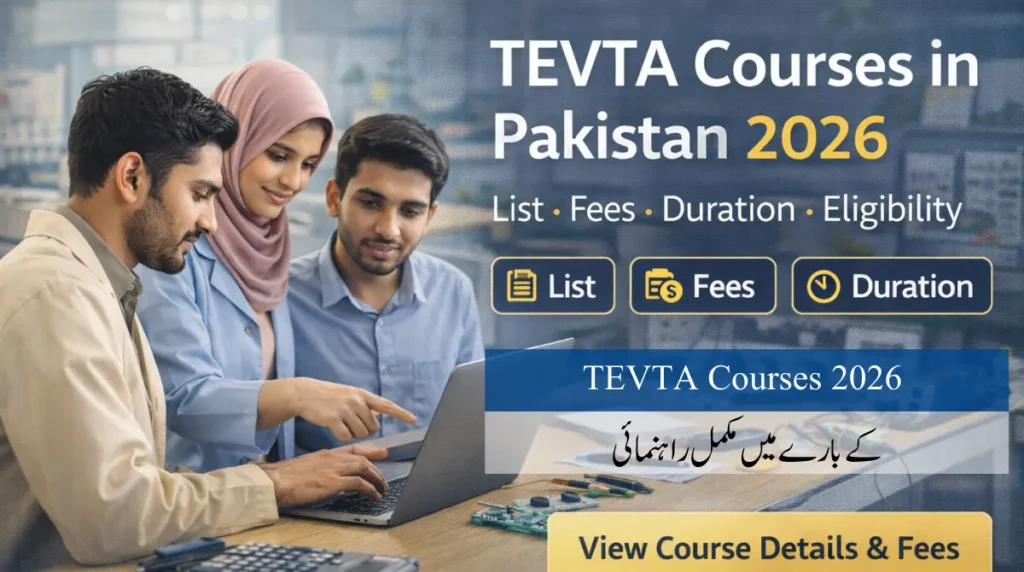
TEVTA courses in Pakistan help students learn real skills that lead to jobs. TEVTA trains students for trades that industry needs. In 2026 TEVTA still stands as a main option for technical learning in many provinces. This guide gives clear steps, fees, course lists and job paths. Read each section and decide what fits your plan.
Quick facts
- TEVTA works in several provinces.
- Courses run from 3 months to 3 years.
- Fees are usually low.
- TEVTA certificates carry government recognition.
- Many courses give fast jobs or self employment.
What is TEVTA
TEVTA means Technical Education and Vocational Training Authority. It runs public training centers. The focus stays on hands on trade training. TEVTA aims to supply skilled workers to local industry. Many students who finish TEVTA move into workshops, factories or start small businesses.
TEVTA by province
TEVTA runs provincial centers. Each province sets admission rules and schedules. Main provinces with TEVTA centers include:
- Punjab TEVTA
- Sindh TEVTA (or Sindh vocational boards)
- Khyber Pakhtunkhwa TEVTA
- Balochistan TEVTA
Check your province portal for exact dates and centres.
TEVTA programs and top trades
TEVTA offers both long diplomas and short skill courses. Below are common options.
Diplomas and long courses (2 to 3 years)
- DAE Electrical
- DAE Mechanical
- Civil Draftsman
- Auto Diesel / Auto Mechanic
- Refrigeration and Air Conditioning (HVAC)
Short courses and certificates (1 to 6 months)
- Electrician basics
- Mobile phone repair
- Welding and fabrication
- Plumbing and pipe fitting
- Computer operator and basic IT
- Tailoring and fashion design
These short courses fit students who need fast income.
TEVTA courses after matric
Many TEVTA diploma courses need a matric pass. Short courses may accept middle or matric. If you just passed matric and want a job fast, choose a short course or a one year certificate. If you want a stronger technical career, choose a DAE or 2 to 3 year diploma.
Fee ranges and cost table
Below is a typical fee guide. Fees vary by province and center. Use this only as a reference.
| Course type | Typical duration | Typical fee (PKR) |
|---|---|---|
| Short course | 1 to 3 months | 2,000 to 10,000 |
| Certificate | 3 to 12 months | 5,000 to 25,000 |
| Diploma (DAE) | 2 to 3 years | 10,000 to 30,000 per year |
Ask the center for the exact fee before you enroll. Look for fee waivers or scholarships.
Course duration and timeline table
| Course level | Study hours | Typical timeline |
|---|---|---|
| Short course | 100–300 hours | 1 to 3 months |
| Certificate | 300–600 hours | 3 to 12 months |
| Diploma | 1,800–3,000 hours | 2 to 3 years |
Plan time for practical work and assessments.
Admission process step by step
Follow these steps to apply:
- Choose the course you want.
- Visit the TEVTA center or the province portal.
- Check eligibility for that course.
- Prepare documents: CNIC, matric certificate, domicile, photos.
- Fill the application form online or at the center.
- Sit any entry test if required.
- Pay the fee and get the receipt.
- Start classes on the given date.
Keep copies of all documents. Ask for the course outline and timetable.
TEVTA is one of the most important technical institutes in Pakistan that provides job-oriented training.
Eligibility rules and documents required
Common eligibility rules:
- Matric for diploma courses.
- Middle or matric for short courses depending on the trade.
- Age limits vary by province and program.
- Domicile may be required for provincial quotas.
Standard documents:
- CNIC or B form
- Matric certificate or result card
- Domicile certificate
- Passport size photos
- Fee payment receipt
Ask the centre for any extra documents.
Job outcomes and expected salaries
TEVTA graduates find work in many sectors. Below are sample salaries for entry level roles. These numbers vary by city and employer.
| Job role | Entry salary (PKR) | After 1 year |
|---|---|---|
| Electrician | 20,000–35,000 | 30,000–50,000 |
| Mobile repair tech | 15,000–30,000 | 25,000–45,000 |
| Welder | 18,000–32,000 | 28,000–45,000 |
| Auto mechanic | 20,000–40,000 | 35,000–60,000 |
| Computer operator | 18,000–30,000 | 25,000–45,000 |
Many students earn more with freelance or small business work.
Best TEVTA courses for girls
TEVTA offers courses suitable for women. These often include:
- Tailoring and fashion design
- Beautician and salon skills
- Office and data entry
- Graphic design and basic web design
- Home based sewing entrepreneurship
Many centres run female-only batches. tevta diploma fees may be waived in some cases for women. Ask local centres about women friendly options.
Internships, apprenticeships and on the job training
Apprenticeships add real work experience. Many TEVTA centres link with local firms. You should ask for internship or on job training. This helps build a CV. Practical work often leads to job offers. Try to do short paid work while training to build trust.
Accreditation, certificate value and recognition
TEVTA certificates come from provincial authorities. These certificates hold value for local employers and for many government technical posts. For overseas jobs check with the employer first. For advanced training you can combine TEVTA with NAVTTC or short IT board courses.
Tips to choose the right TEVTA course
- Match the course to local job demand.
- Check course length and cost.
- Visit the training centre first.
- Ask about placement support.
- Request to see a sample certificate.
- Ask if tool kits or starter support exist.
- Prefer centres with industry tie ups.
Make a shortlist of three courses and compare them.
FAQ (short answers)
Q: Can I join TEVTA with a middle pass?
A: Yes, for many short courses middle pass is acceptable. Check course details.
Q: Do TEVTA courses give placement help?
A: Some centers offer placement support. PSDF partners offer stronger placement.
Q: Are TEVTA certificates valid for government jobs?
A: TEVTA diplomas are valid for many technical government posts. Check the job ad.
Q: How soon can I start earning after a short course?
A: Many students start small jobs in one to three months after short courses.
Q: Do TEVTA centers charge high fees?
A: Fees are generally low. Private centers charge more. Always ask for official receipts.
Conclusion
TEVTA gives clear paths to jobs and skills. Courses fit many budgets and timelines. For fast income choose short skill courses. For a longer technical career choose DAE or diploma. Check the centre, confirm fees and ask about placement before you enroll. Use study, practice and internships to increase your chances of steady work.
About DailyPostJob.com
DailyPostJob.com helps students and job seekers in Pakistan. We publish guides, admission alerts and free PDF notes. If this guide helped you, share it with friends. Join our WhatsApp and Telegram lists for free PDF notes and course alerts. We add new guides and sample papers often to help students succeed.
Explore Our More Latest Articles:
PPSC MCQs Preparation 2026 – Free Practice Questions for Written Test
Hijazi
PPSC Past Papers PDF 2026 Free Download | DailyPostJob
Hijazi
PPSC Interview Preparation 2026 – Complete Guide to Pass Your Interview
Hijazi
PPSC Result 2026 – Check Merit List, Written Test & Final Selection
Hijazi
PPSC Test Schedule 2026 – Written Exam Dates & Timings
Hijazi