
- Table of Contents
- Introduction
- Why this guide matters
- Quick action checklist
- Key dates and admission calendar 2026 (table)
- How university admissions work in Pakistan
- Online apply portals and step by step guide
- Common portal problems and fixes (table)
- How merit is calculated with examples (tables)
- Entry tests you must know
- Province wise rules and quick notes
- Program wise admission paths
- Six month admission preparation roadmap
- Interview preparation guide
- Common interview questions and sample answers
- Interview tips
- Parent guidance and fee planning
- Hostel and city safety tips
- Common mistakes that cause rejection
- Hostel and city selection guide
- Tools and downloads to add on DailyPostJob.com
- Bonus section — build long term success
- Conclusion
- About DailyPostJob.com
Introduction
Last Updated: January 11, 2026
University Admissions in Pakistan 2026 is the start of a new academic journey for many students. This guide gives clear, step by step help. You will find dates, rules, and tools. You will learn how to avoid common mistakes. You will get simple examples for merit calculation. Use this guide as a checklist. Save it and share it with friends.
Why this guide matters
Admission season can feel hard. Deadlines come fast. A small error can cost a seat. Many students miss a date or submit the wrong file. This guide puts all key items in one place. It cuts the time you spend searching. It reduces stress. It helps you act fast and with confidence.
Quick action checklist
- Read official university notices first.
- Keep scanned documents ready.
- Make one secure email for admission use.
- Pay fees on time and save receipts.
- Print the submitted form.
- Set reminders for test dates and deadlines.
How To Apply Online University Admissions in Pakistan 2026 — Complete Guide” →
/university-admissions-pakistan-2026
Key dates and admission calendar 2026
Below is a simple month by month calendar. Use this as your base. Check the university site for exact dates. Update your calendar when official notices appear.
| Month | Action |
|---|---|
| January | Early announcements from private universities |
| February | Application windows open for some programs |
| March | Entry test registration starts |
| April | Many application deadlines close |
| May | First merit lists appear |
| June | Final merit lists and fee confirmation |
| July | Late admissions and special intakes |
| August to November | New academic year and orientation |
You can add these dates to your phone calendar. Set a reminder one week before each deadline. Set another reminder one day before.
How university admissions work in Pakistan
Most universities follow a simple flow. Steps may differ by program and by university. Public and private rules may differ. Read the official notice for each program.
Basic admission flow
- University issues an admission notice.
- Candidate reads the notice and checks eligibility.
- Candidate creates an account on the portal.
- Candidate fills the form and uploads documents.
- Candidate pays the fee and saves the receipt.
- University runs entry tests or checks previous marks.
- University publishes the merit list.
- Selected candidates confirm their seat.
- Final registration and orientation follow.
Public university points
- Public universities often use a strict merit formula.
- They weigh board marks, test scores and interview.
- Deadlines are usually firm.
Private university points
- Private universities may use tests and interviews.
- They may offer merit or need based scholarships.
- They may hold seats for late confirmation.
See full admission calendar:” →
/Admission Calendar Pakistan 2026
Online apply portals and step by step guide
Most universities use an online portal. Some use regional portals. Use this step by step list to avoid errors.
Step by step apply guide
- Read the admission notice. Check program code and eligibility.
- Create an account on the official portal. Use a secure password. Use an email you control.
- Prepare scanned files. Keep separate files for CNIC or B form, matric marksheet, intermediate marksheet, passport photo, and fee slip. Use clear PDF or JPG files.
- Fill the form with exact name and date of birth as on CNIC or B form. Do not use nicknames.
- Choose program code carefully. Wrong code may reject your form.
- Upload files within size limits. Rename files with a clear format like Name_CNIC.pdf.
- Pay the fee through the portal option. If portal shows bank challan, submit the challan at the bank and upload the receipt.
- Review every field. Submit before the deadline.
- Print the submission confirmation and the payment receipt. Keep screenshots as proof.
Tips for a smooth application
- Use a laptop or desktop. Portal features may fail on some phones.
- Use Google Chrome or Firefox for portals.
- Use a stable internet connection.
- Save login details in a secure place.
Common portal problems and fixes
| Problem | Likely cause | Quick fix |
|---|---|---|
| Upload error | File too large or wrong format | Compress file or convert to PDF |
| Payment failed | Bank or card issue | Use challan or another card |
| Missing fields error | Required fields empty | Recheck form and fill every field |
| Portal timeout | Slow internet or server load | Try again during low traffic hours |
| Forgot password | No access to email | Use portal help or support number |
If the portal gives an error you cannot fix, contact the university help desk. Keep the error screenshot and the time stamp.
How merit is calculated with examples
Merit formulas vary by university and by program. This section shows simple models. Use these to estimate your score. Always check the official formula for the program you apply to.
Common weighted model for general undergraduate program
- Board marks 50 percent
- Entry test 40 percent
- Interview or extra 10 percent
Worked example 1
| Component | Marks | Weight | Weighted score |
|---|---|---|---|
| Board marks | 880 of 1100 | 50% | 40.00 |
| Entry test | 160 of 200 | 40% | 32.00 |
| Interview | 8 of 10 | 10% | 8.00 |
| Total | 80.00 |
In this example the final merit score is 80.00. The university ranks candidates by this score.
Worked example 2 for MBBS programs
Many provinces use a special formula for MBBS.
- Matric marks 10 percent
- FSc marks 50 percent
- MDCAT score 40 percent
Sample numbers
| Component | Score | Weight | Weighted |
|---|---|---|---|
| Matric | 900/1100 | 10% | 8.18 |
| FSc | 920/1100 | 50% | 41.82 |
| MDCAT | 150/200 | 40% | 30.00 |
| Total | 80.00 |
Exact formulas change by province. Some public medical colleges use a local variation. Check the official notice for MDCAT weight and conversion rules.
Notes on normalization
Some universities normalize board marks from different boards. The goal is to make marks comparable. Normalization rules can affect final merit. Read the university rule section about normalization.
Entry tests you must know
Entry tests form a large part of merit for many programs. Know the key tests and where to find the official info.
MDCAT
- Used for MBBS and BDS.
- Check the official testing authority for date and syllabus.
- Register on the official portal. Save your roll number and admit card.
ECAT
- Used for engineering programs in many universities.
- Some engineering faculties run their own ECAT.
- Check whether your target university accepts a central ECAT or the local version.
GAT and NET
- GAT often applies for graduate admissions.
- NET applies for PhD or research programs in some cases.
- Universities may use other tests for MBA or business programs.
University specific tests
- Some top private universities run their own admission test.
- These tests may include reasoning, math, and English.
- They may combine the test with interviews.
Test day checklist
- Carry original CNIC or B form.
- Carry printed admit card.
- Reach the center one hour early.
- Carry required stationery only. Follow test rules.
Study tips for tests
- Solve past papers under exam time.
- Revise the high weight topics first.
- Use short daily practice sessions. Do not cram at the last minute.
- Join a focused study group if it helps you stay on track.
Province wise rules and quick notes
Universities in each province follow similar steps. Rules and weightages may differ. Check the official notice for exact formulas and dates.
Punjab
- Many public universities use a clear merit formula.
- Some programs use a local entry test.
- Deadlines stay firm. Meet each date.
- Keep a copy of fee slips and forms.
Sindh
- Some universities publish separate merit lists for local and non local students.
- Private universities may hold interviews.
- Watch for provincial quota rules.
- Always use the university portal link in the official notice.
Khyber Pakhtunkhwa
- Some departments use entrance tests and interviews.
- Check rules for reserved seats.
- Keep original documents ready for verification.
Balochistan
- Admission windows can be small.
- Contact the university admission office if notices are late.
- Allow more time for document courier if needed.
| Province | Common action |
|---|---|
| Punjab | Use official portal. Check normalization rules. |
| Sindh | Check local quotas and separate lists. |
| KPK | Confirm reserved seats and test rules. |
| Balochistan | Contact admission office early for updates. |
Program wise admission paths
Different programs follow different steps. Here are the common paths for major streams.
MBBS and BDS
- Check MDCAT dates first.
- Collect FSc and Matric marksheets.
- Many colleges use MDCAT weight plus FSc weight.
- Apply to public and private colleges early.
- Look for reserved seats and provincial quotas.
Engineering
- Check whether ECAT or university test applies.
- For some programs the university uses a separate test and interview.
- Prepare math and physics topics well.
- Include portfolio if you have projects or practical work.
Computer Science and IT
- Many universities accept FSc with math.
- Some require a short test for logical and coding basics.
- Show programming projects or certificates if ready.
- For private universities, an interview may matter.
Business and Commerce
- Many programs use prior marks.
- Some top schools use admission tests and interviews.
- Prepare for basic math and English.
- Show any formal internship or work if available.
Law
- Check entry test and interview requirements.
- Many law schools value writing ability and clarity.
- Prepare a short statement of purpose if required.
Education
- Some programs require teaching practice or a short interview.
- Include any volunteer or teaching experience.
| Program | Key documents | Common tests |
|---|---|---|
| MBBS | FSc, MDCAT, CNIC | MDCAT |
| Engineering | FSc, CNIC, transcripts | ECAT or university test |
| CS | FSc, transcripts | University test or interview |
| Business | FSc or equivalent | University test or interview |
| Law | Transcripts, CNIC | University test, interview |
| Education | Transcripts, experience | Interview |
Six month admission preparation roadmap
Use this roadmap as a guide. Adjust dates to match each university notice. Start early to avoid last minute errors.
| Months before deadline | Focus |
|---|---|
| 6 months | Research programs and universities. List top 5 choices. |
| 5 months | Register for entry tests. Start focused study. |
| 4 months | Gather documents and arrange scans. Book test slots. |
| 3 months | Practice past papers. Finish basic revision. |
| 2 months | Final review and minor corrections to forms. |
| 1 month | Submit applications and pay fees. Print confirmations. |
| 2 weeks | Prepare for interviews. Pack documents. |
| Test day | Reach early. Carry original ID and admit card. |
| After results | Check merit list and confirm seat quickly. |
Interview preparation guide
Interviews decide seats in many private universities. Use simple steps. Be ready and be calm.
Before the interview
- Read the program brochure. Know course length and fees.
- Prepare short answers for common questions.
- Dress neat and arrive on time. Carry originals and copies.
Common interview questions and sample answers
Q. Tell us about yourself.
A. Give one short paragraph. Start with name, city, recent study and one goal. Keep it under 30 seconds.
Q. Why this program?
A. Give one clear reason linked to career goals. Avoid generic lines.
Q. What are your strengths?
A. Pick two strengths. Give one short example for each.
Q. How will you handle study load?
A. Show a plan. Say you will use a timetable and review each week.
Q. Do you have questions for us?
A. Ask one or two real questions about internships or labs.
Interview tips
- Speak slowly and clearly.
- Look at the panel, not the floor.
- Keep answers short and on topic.
- If you do not know an answer, say you will learn it and ask for guidance.
- Send a short thank you email after the interview if contact details exist.
Parent guidance and fee planning
Parents play a big role. Help the student and plan finances early.
Fee planning steps
- List annual fees and one time charges like admission and security deposit.
- Add living cost if the student moves to a new city.
- Check scholarship and payment plan options.
- Save copies of fee receipts and bank challans.
| Item | Action |
|---|---|
| Fee amount | Confirm annual and semester fees |
| Payment plan | Ask for monthly or semester plan |
| Scholarship | Check eligibility and apply early |
| Proof | Save all receipts and payment proofs |
Hostel and city safety tips
- Check hostel rules and security.
- Visit the hostel if possible before payment.
- Confirm distance to campus and commute options.
- Prefer hostels with positive reviews and a local contact.
Common mistakes that cause rejection
Avoid these common errors. Keep a final checklist before submit.
| Mistake | Why it fails | How to fix |
|---|---|---|
| Wrong program code | University rejects form | Double check code before submit |
| Name mismatch | ID does not match | Use name as on CNIC or B form |
| Upload low quality files | Verification fails | Scan documents clearly as PDF |
| Late payment | Application not accepted | Pay early and save receipt |
| Missing signature | Form invalid | Check all signature fields before submit |
| Wrong photo size | Upload error | Follow format rules in notice |
Hostel and city selection guide
Moving to a new city is a big step. Pick the right place with care.
- Choose hostels close to campus if daily commute is long.
- Check food options and hygiene. Ask other students.
- Confirm laundry, internet and power backup.
- Check rules for visitors and curfew.
- Look for hostels with emergency contact and first aid.
If you plan to live with a guardian, verify their address with the university if the university requires local guardianship.
Tools and downloads to add on DailyPostJob.com
Offer tools that students share. These tools build trust and visits.
- Merit calculator spreadsheet with weighted fields.
- Admission checklist PDF.
- iCal file with major dates.
- Sample filled application form PDF.
- Past papers and solved guides for MDCAT and ECAT.
- Short video guide on how to upload files and pay online.
Each tool should come with a small note that explains how to use it. Keep the file sizes small. Offer both PDF and Google Sheets versions when possible.
Bonus section — build long term success
This section helps students stay ahead after admission.
Career planning
- Choose subjects that match job goals.
- Meet faculty and ask about internships.
- Attend career events and workshops.
Skill building
- Learn one programming language or tool relevant to the course.
- Take short online courses. Pick applied skills.
- Build a simple project to show during internships.
Portfolio and CV
- Keep a folder of school projects and certificates.
- Create a short CV with contact info, education and skills.
- Use free templates and update the CV each semester.
Networking
- Join student clubs and societies.
- Connect with seniors and alumni for advice.
- Start a LinkedIn profile and keep it professional.
How DailyPostJob.com can help you long term
DailyPostJob.com will publish updated admission notices. The site will add new tools each season. You can download checklists, the merit calculator and past papers. Join the newsletter for alerts on deadlines. Follow the Telegram channel for quick updates.
Final checklist before you submit
- Read the admission notice twice.
- Check program code and eligibility.
- Scan and name documents clearly.
- Pay fees and save receipt.
- Print confirmation and keep digital backup.
- Set reminders for interview and orientation.
FAQs about university admissions in Pakistan 2026
Q 1. What documents do I need to apply to a public university?
A. You need CNIC or B form, matric and intermediate transcripts, passport size photo, and the fee deposit slip. Some programs require extra documents.
Q 2. When do universities publish admission merit lists?
A. It varies. Many publish lists after the entry test and after applying deadlines. Check the university admission page.
Q 3. Can diploma holders apply for degree programs?
A. Yes in many cases. The university will check equivalence and credit transfer rules.
Q 4. How can I get a scholarship?
A. Check both the university and government scholarship pages. Prepare your documents and apply before the scholarship deadline.
Q 5. What to do if my name is on the merit list?
A. Confirm your seat by paying the fee and submitting required documents. Follow the timeline provided in the merit notice.
Conclusion
This guide covers the key steps for university admission in Pakistan for 2026. Use the calendar and roadmap. Follow portal instructions. Prepare for tests and interviews. Keep all documents ready. Act fast when the merit list appears. A careful plan will save time and stress.
About DailyPostJob.com
DailyPostJob.com helps students and job seekers in Pakistan. Share this guide with friends who plan to apply. Download our free PDF checklists, merit calculator spreadsheet and admission calendar. Join our newsletter and Telegram for real time alerts and past papers.
Explore Our Latest Articles:
PPSC MCQs Preparation 2026 – Free Practice Questions for Written Test
Hijazi
PPSC Past Papers PDF 2026 Free Download | DailyPostJob
Hijazi
PPSC Interview Preparation 2026 – Complete Guide to Pass Your Interview
Hijazi
PPSC Result 2026 – Check Merit List, Written Test & Final Selection
Hijazi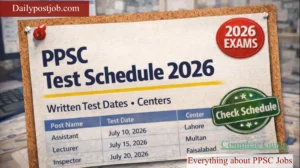
PPSC Test Schedule 2026 – Written Exam Dates & Timings
Hijazi